Skip to content

Research

Quantum algorithms and quantum circuits

Part of my research focuses on quantum algorithms for simulating molecules and materials on near-term quantum computers. Symmetry-adapted encodings build a molecule's symmetries into its qubit mapping, compressing electronic structure onto fewer qubits, and now extend to complete active spaces and the Bravyi–Kitaev mapping and, via space groups, to crystalline solids; they are implemented in the open-source package QuantumSymmetry. I also work on a quantum formulation of the R-matrix method for electron–molecule scattering.

I developed a hardware-efficient ansatz that represents quantum states as a binary tree, pruning redundant gates to keep circuits compact. Its exact, diagonal geometric metric enables natural-gradient optimisation and variational real- and imaginary-time evolution without extra metric measurements or matrix inversion.
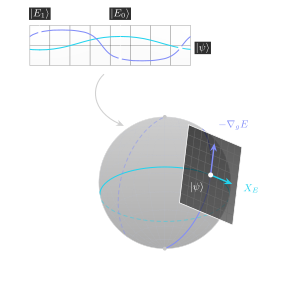
An energy landscape and Bloch sphere showing natural-gradient and real-time quantum-state evolution.
The geometry. A diagonal Fubini–Study metric turns energy gradients into real- and imaginary-time evolution.
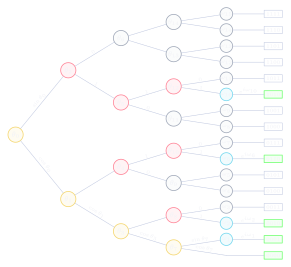
A binary tree of controlled rotations with active, fixed and inactive nodes leading to computational-basis states.
The parametrization. A binary tree of controlled rotations; nodes are active, fixed, or inactive (gauge).
A four-qubit circuit with redundant gates pruned and cancelling CNOT pairs marked in orange.
The circuit. Gauge-fixing prunes redundant gates and cancels CNOT pairs, so the two-qubit count grows linearly in the number of active basis states k.

Information geometry of machine learning

I work on large language models through the geometry of their probability distributions. A model's output distribution carries a natural geometry, the Fisher–Rao metric, and two questions drive the work: how much of that geometry is shared between models trained separately, and how it can be used to steer or edit a model's behaviour with minimal collateral change.

The same picture serves as a lens for interpretability, reading a model's learned features as directions in the space of its predictions. The paper and its interactive companion present the findings and accompanying experiments.
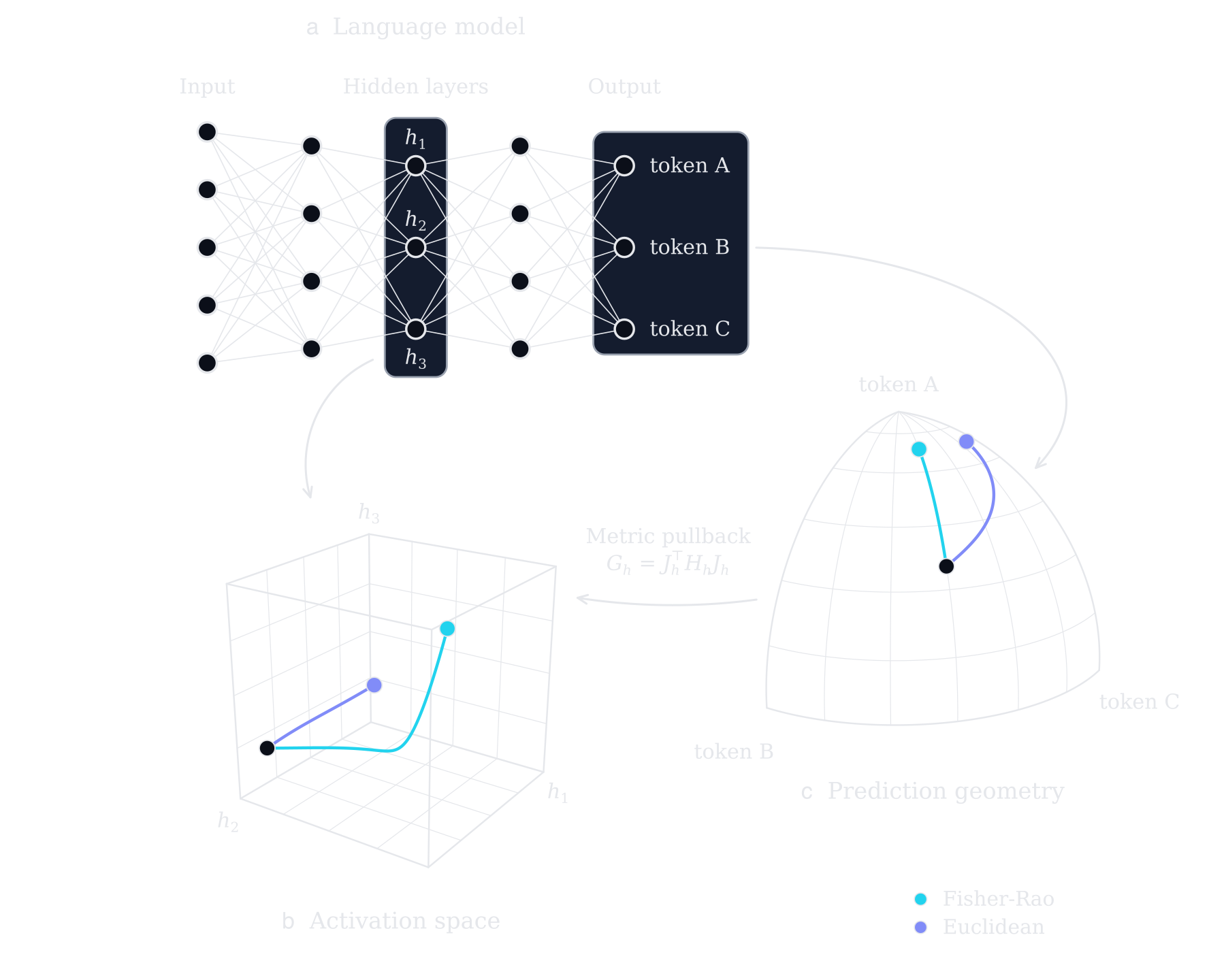
A language model connects hidden activations to next-token probabilities. Cyan Fisher–Rao and indigo Euclidean steering trajectories are shown in activation space and prediction geometry.
From activations to predictions. The same steering trajectories are shown in a model’s activation space and in the geometry of its next-token predictions. Euclidean updates use distances in activation coordinates; Fisher–Rao updates measure change through its effect on the output distribution.

Quantum gravity and foundational physics

I work on quantum gravity through holography and quantum information, asking how the structure of a quantum theory can encode spacetime and gravitational physics. My interests include entanglement and the relationship between quantum information and geometry, as well as foundational and philosophical questions in quantum mechanics. This work grew out of my MSc thesis on quantum-informational approaches to gravity and the gauge/gravity duality.
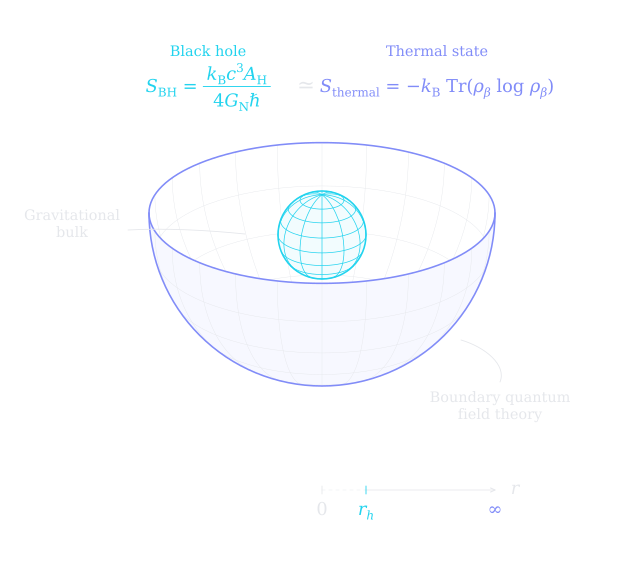
A cyan wireframe black-hole horizon inside an indigo-accented quantum-field-theory boundary. Above the drawing, black-hole entropy is k B c cubed A H divided by four G N h bar, and thermal entropy is minus k B times the trace of rho beta log rho beta. The two entropies agree at leading semiclassical order. Below, a schematic radial guide marks zero, the horizon radius r h, and infinity at the boundary. The black-hole interior is not depicted.
Two descriptions of one system. A large AdS black hole and a thermal boundary state have the same entropy at leading semiclassical order in Einstein gravity. Here ρβ= e−βH/Z , with β=1/(kBT). The spatial cutaway suppresses time and dimensions; the conformal boundary at infinity is drawn at finite size.

Computational simulations for science and engineering

Alongside my academic research, I am co-founder and managing director of Tanuki, which builds AI-assisted computational simulation for science and engineering, shortening the path from a physical problem to a solved, trustworthy model.

Through Tanuki we contribute computational simulation to Re-thickening Arctic Sea Ice (RASI), a University of Cambridge-led programme funded by ARIA investigating whether Arctic sea ice can be artificially thickened during the polar winter so it survives longer into summer; our contribution models the mechanics of the ice, how thickened sea ice deforms and fractures under stress. This work has been covered by the Guardian and the BBC.

A white triangular mesh of simulated sea ice in Nares Strait, with fractures across the southern ice pack and a thicker white coastline. Deformation is shown at its actual scale.
Sea-ice deformation and fracture. A Tanuki finite–discrete element simulation of sea ice in Nares Strait, showing the deformed mesh and fractures at their actual scale.
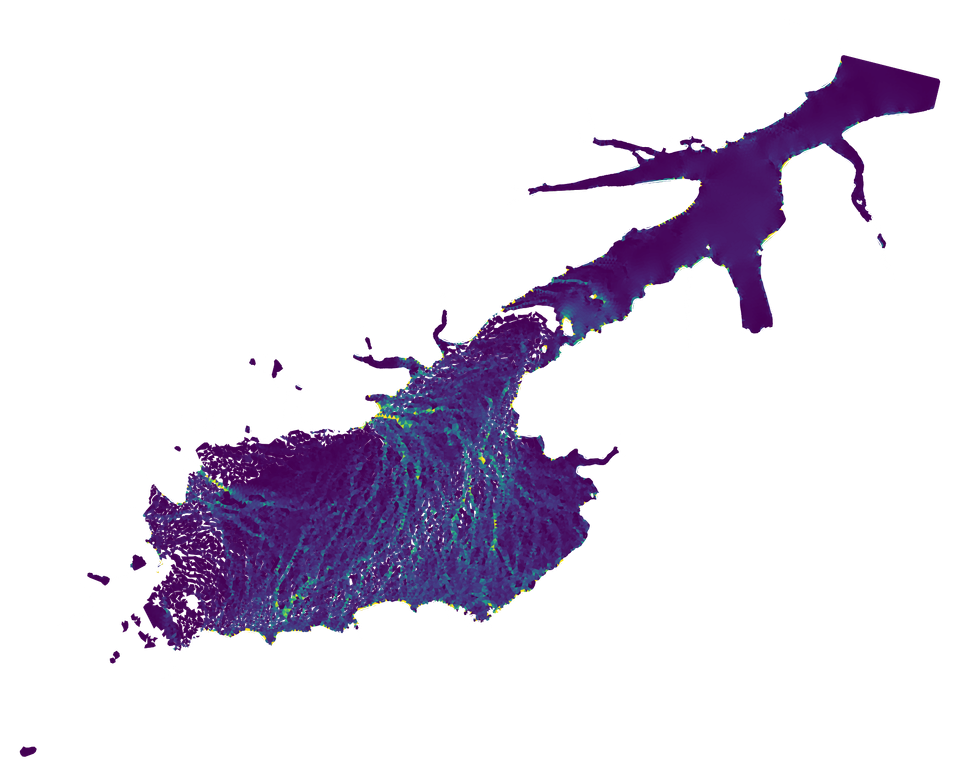
The same fractured sea-ice geometry coloured from purple through green to yellow by von Mises stress, with a thicker white coastline. The colour scale runs from zero to 60-plus kilopascals.
Stress in fractured sea ice. Von Mises stress in the same Tanuki simulation frame, showing stress concentrations within the ice pack.
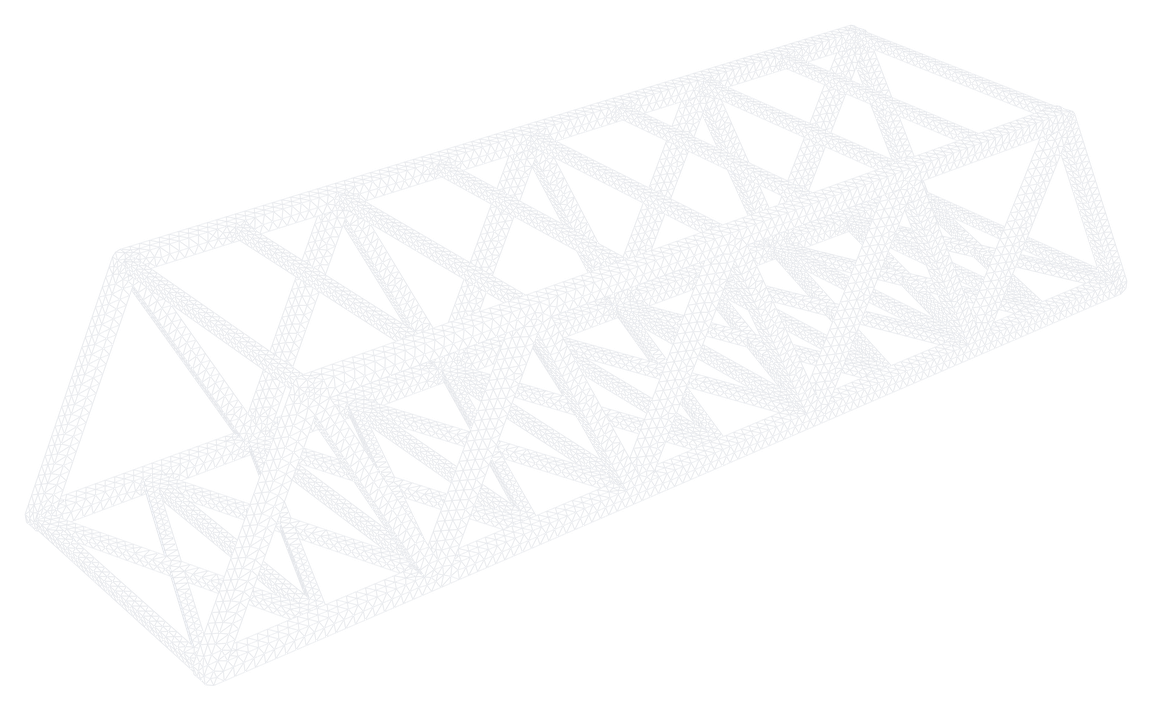
The original Warren-truss CAD surface shown as a white triangular mesh on a transparent background.
The structural mesh. A Warren-truss CAD surface mesh generated with Tanuki for a structural-engineering simulation.
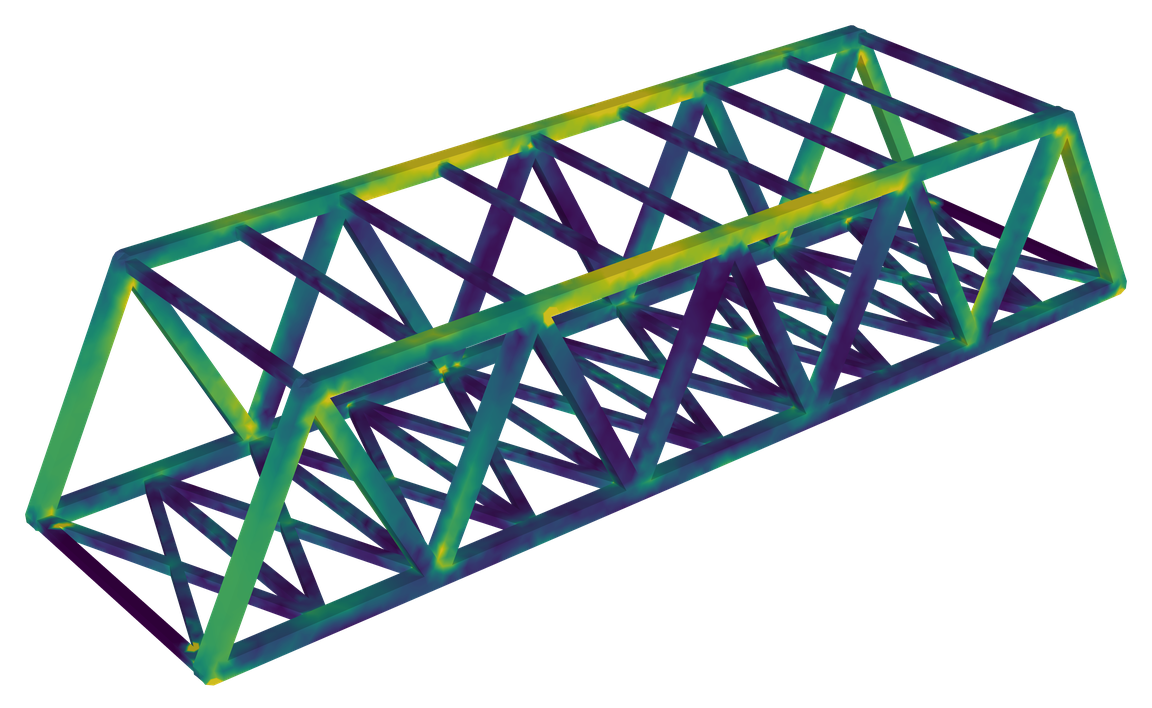
An oblique view of a steel Warren truss coloured from purple to yellow by increasing von Mises stress under its own weight.
The stress field. A Tanuki structural-engineering simulation of a steel Warren truss under its own weight.